
The short answer: an AI SEO agent can accelerate investigation, but it should not be allowed to manufacture a diagnosis
AI can be useful in technical SEO. It can group crawl errors, compare page templates, search deployment notes, summarise logs, list plausible causes and draft a verification plan. Those are valuable accelerators. The danger begins when a plausible suggestion is treated as a proven cause and sent directly to a production queue.
A new published benchmark from iPullRank, WARRANT-SEO, makes that distinction unusually clear. The study tested 27 models across 27 SEO diagnostic scenarios. When models received the one decisive observation that made a diagnosis supportable, iPullRank reports a 99% correct-diagnosis rate. When that single observation was removed, the report says appropriate recognition that the evidence was insufficient fell to 51.5%.
That does not mean every AI system will fail in the same way, or that the result predicts a live production incident. It is a curated benchmark with a fixed August 2026 response corpus. But it is a useful warning: a fluent, repeatable technical answer is not necessarily a supported one.
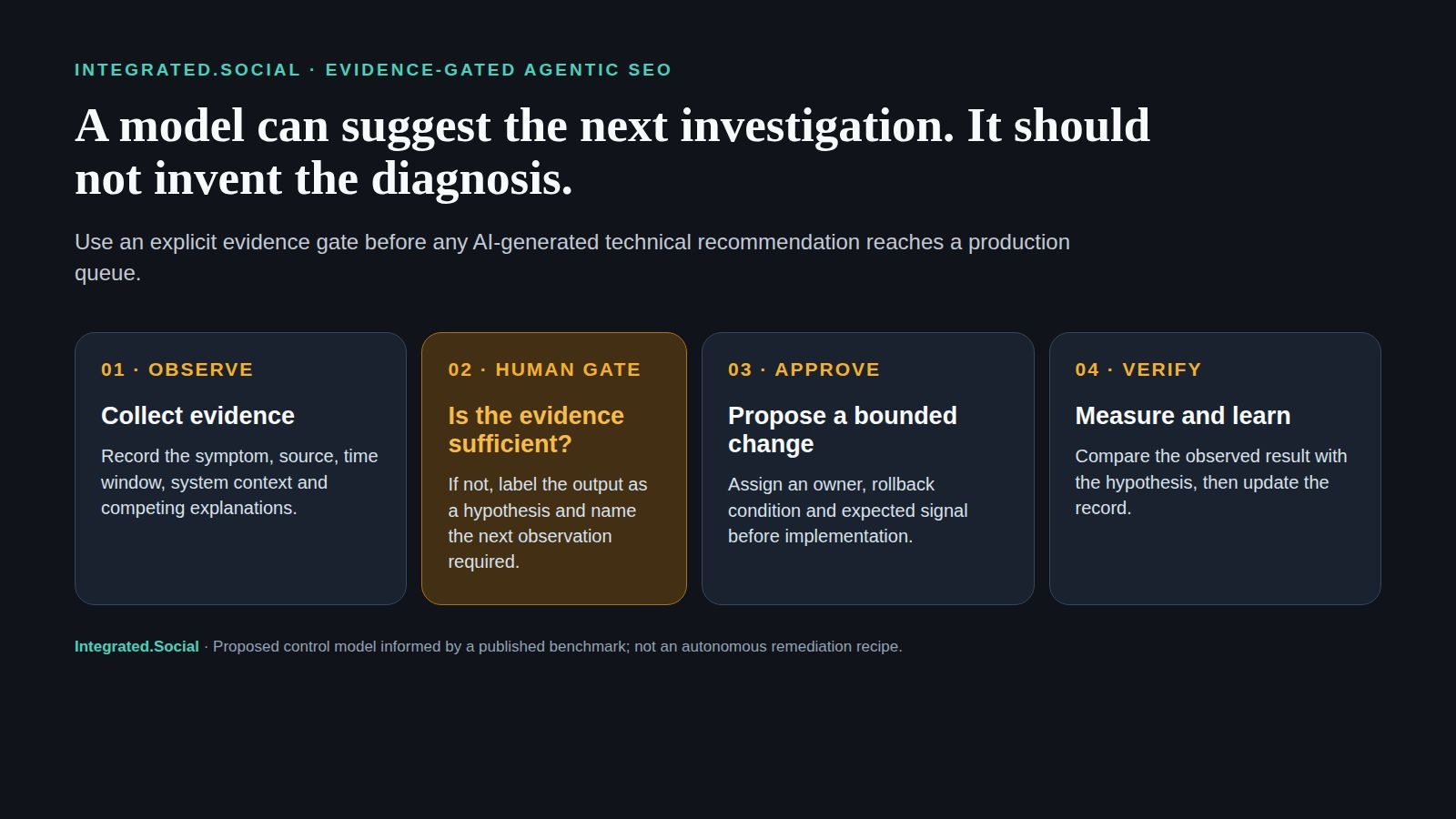
The operating rule: an AI agent may propose what to investigate. It must not label a cause as established, change a site or publish a recommendation until the evidence supports the claim and a named human approves the action.
What the WARRANT-SEO benchmark actually measured
iPullRank says it built 27 scenarios from real-world SEO diagnostic experience and tested each in three versions. In the first, the model had the decisive observation that ruled out competing explanations. In the second, it had the same evidence with an additional option to say that the evidence was insufficient. In the third, the decisive observation was removed, leaving more than one plausible cause; abstaining from a specific diagnosis was the only correct answer.
The report says the full set was run three times across 27 models: 81 questions, 6,561 responses and 6,427 scored responses, with a reported reliability score of 0.969. It also reports a 47.5-point gap between the evidence-present and evidence-removed cases.
Why this matters for AI SEO agents
Technical SEO rarely arrives as a clean multiple-choice problem. Traffic can move because tracking changed, a page template regressed, canonicalisation shifted, crawling slowed, inventory changed, a deployment introduced a rendering issue or a search feature changed the demand pattern. Several explanations can look plausible from the same headline symptom.
A model that sees only part of the record may produce a confident story because that is what language models are designed to do: continue a pattern. Repeating the prompt is not independent verification. Asking a second model can be useful, but it does not automatically create the missing observation. The missing evidence has to be collected.
Evidence-Gated Agentic SEO: a practical operating model
Evidence-Gated Agentic SEO is an Integrated.Social operating model proposed for teams using AI in diagnosis and remediation. It is not an industry standard, an iPullRank product or a claim that an agent can safely run technical SEO by itself. Its purpose is to make the boundary between a hypothesis and a production recommendation visible.
1. Capture the observed symptom and its source
Start with an event that can be inspected: a crawl report, server log, Search Console export, analytics change, deployment record, structured-data validation, rendered HTML capture or user journey. Record the time window, affected routes, source system and data-quality limitation.
“Organic traffic fell” is not enough. A useful record says which property, channel, page group, device, country and comparison window are involved; whether analytics instrumentation changed; and whether the symptom was independently reproduced.
2. Ask the agent for competing causes, not a single answer
An agent can usefully generate a short hypothesis set. Require it to label each candidate cause with the observation that would support it, the observation that would contradict it and the next evidence needed to distinguish it from other causes.
This changes the interaction from “tell me what is broken” to “help me choose the next test”. It also prevents a familiar diagnosis—such as cannibalisation, rendering failure or crawl budget—from becoming a default answer when there is not enough evidence.
3. Apply an evidence sufficiency gate
A sufficiency gate asks a simple question: does the current record rule out the relevant alternatives well enough to make a causal recommendation? If no, the output must say insufficient evidence, preserve the hypotheses and specify the next observation required.
A hypothesis is useful; an unsupported production task is not
A hypothesis can focus a human investigation. It becomes dangerous when it is translated into a change ticket, a client recommendation or a live deployment without a verified observation. The difference is not bureaucracy. It is the difference between a bounded experiment and a potentially costly misdiagnosis.
4. Give a human owner the decision rights
The named reviewer should understand both the evidence and the downside of the proposed change. They approve the scope, owner, rollback condition and verification signal. The agent can prepare the record, but it does not approve itself.
For a low-risk content clarification, the approval path may be lightweight. For canonicals, robots directives, redirects, conversion tracking, consent, access control or template changes, the gate should be stricter because a confident error can affect many pages or customers.
5. Verify the effect and update the record
Every approved change needs an expected signal and a check date. Did the rendered HTML change as intended? Did the validator pass? Did the affected crawl, impression or conversion signal move? Were there unintended side effects? Attach the result to the original evidence record so the team can learn which hypotheses and prompts were reliable.
A minimum evidence record for AI-assisted SEO work
| Field | What to capture | Why it protects the team |
|---|---|---|
| Symptom | Specific route group, signal and time window | Prevents vague diagnosis |
| Evidence | Source URL or export, timestamp and relevant observation | Makes the claim inspectable |
| Alternatives | At least two viable causes where uncertainty remains | Stops premature closure |
| Gate decision | Supported, hypothesis only or insufficient evidence | Sets the permitted next action |
| Owner | Named human approver and implementer | Keeps accountability clear |
| Rollback | How the change is reversed if harm appears | Limits deployment risk |
| Verification | Expected signal, method and review date | Separates action from proof |
Where an AI SEO agent helps most
The strongest use cases are evidence handling and repeatable preparation. An agent can identify fields missing from a report, normalise issue descriptions, cluster similar routes, map a template footprint, draft a test plan, compare visible copy with schema, or prepare a human-readable change brief.
It is less suitable as an unsupervised authority for broad changes. “Add noindex”, “redirect these URLs”, “delete these canonicals” and “rewrite all FAQs” are not merely text outputs. They change a public system. They require verified input, scoped authority and a way back.
A safe first pilot
Choose one bounded use case such as classifying internal crawl observations or drafting a page-level evidence brief. Keep the action read-only at first. Compare the agent’s structured record with a human-reviewed baseline. Measure whether it improves evidence completeness, triage time and reviewer confidence—rather than only whether it produces a fast answer.
Then make the approval criteria explicit. What must be true before a human signs off? Which missing evidence triggers an escalation? Which changes remain prohibited? A controlled pilot creates a decision record before it creates a dependency.
What this means for AEO and AI search
AEO and technical SEO involve the same discipline. An answer engine may surface a concise claim, but your own site needs to be able to support it with visible evidence, current definitions, accessible copy and coherent structured data. An internal AI assistant should follow the same rule: a useful conclusion has an evidence trail, a scope and an owner.
This is also why a score alone is not an operating system. A Free AI Visibility Score can highlight high-level patterns, but it should not disclose or execute protected diagnostics. A team still needs to inspect the evidence, decide what matters commercially and choose a safe next action.