AI Answer Summary
Gallup's Q1 2026 workforce survey, conducted with 23,717 employed US adults between 4-19 February 2026, contains a data point that should be on every CMO's agenda: employees in AI-adopting organisations are significantly more likely to report workforce reductions than their counterparts in non-AI.
The Gallup Finding Every Marketing Leader Needs to Read
Gallup's Q1 2026 workforce survey, conducted with 23,717 employed US adults between 4-19 February 2026, contains a data point that should be on every CMO's agenda: employees in AI-adopting organisations are significantly more likely to report workforce reductions than their counterparts in non-AI organisations (23% vs 16%). More critically, the pattern of who is being let go reveals a structural divide that goes far beyond individual productivity.
The headline statistic that has circulated widely - that AI non-users face roughly three times the layoff risk of regular AI users - is consistent with Gallup's own finding that 18% of workers who use AI less than monthly report their role is at risk of elimination within five years, compared to 6% of those who use AI monthly or more frequently. This is not a prediction. It is a present-tense measurement of how AI adoption correlates with job security right now, across 23,717 real workers.
The critical nuance: Gallup is explicit that only 1% of recently laid-off workers cite AI as the primary cause. The mechanism is not direct replacement - it is competitive displacement. Workers who have not integrated AI into their workflows are delivering outputs at a pace and cost that their AI-augmented colleagues can match in a fraction of the time. When headcount decisions are made, the non-adopters are disproportionately visible as the lower-productivity cohort.
For B2B marketing leaders, this is not an abstract workforce policy question. It is a talent strategy, competitive positioning, and operational resilience question - all at once.
What the Broader Research Confirms: Five Datasets, One Direction
The Gallup finding does not stand alone. Five major research programmes published in 2026 all point to the same structural shift, each adding a different dimension to the picture.
1. PwC 2026 Global AI Jobs Barometer: The Two-Track Labor Market
PwC's 2026 AI Jobs Barometer, which analysed more than one billion job advertisements across 27 countries and territories, identifies what it calls a "two-track" global labour market. On one track are "professionalised" roles - positions where AI automates routine tasks and amplifies human expertise, such as strategic planners, data analysts, and senior content strategists. On the other track are "democratised" roles - positions where AI makes the task itself easier for non-experts, reducing the premium on specialist skills, such as junior copywriters and basic data entry roles.
The divergence between these two tracks is stark. Professionalised roles are seeing twice the growth in available jobs and 42% faster salary growth than democratised roles. The average wage premium for workers with AI skills has risen to 62%, up from 57% in 2025. Jobs requiring specific AI skills - prompt engineering, machine learning, AI agent orchestration - are growing at 69% annually, roughly eight times faster than the overall jobs market at 9%.
Most significantly for marketing leaders: the top 20% of companies most exposed to AI achieved average labour productivity growth of 163% relative to their 2018 baseline - nearly five times higher than the average for AI-exposed companies overall. These "superstar companies" are not cutting headcount. They are growing it faster (52% headcount growth vs 36% for the least AI-exposed companies). The implication is direct: AI adoption is not a cost-reduction play for the best performers. It is a growth play.
2. BCG AI at Work 2026: 74% of Frontline Workers Are Now Regular Users
BCG's fourth annual AI at Work survey, conducted with close to 12,000 frontline employees, managers, and leaders across more than a dozen global markets, marks what the report calls a "turning point." For the past several years, only around 50% of frontline workers reported using AI daily or several times a week. In 2026, that figure jumped to 74% - an increase of 23 percentage points in a single year.
The productivity data within this cohort is compelling. Of frontline employees who are regular AI users, 42% report saving eight hours per week - the equivalent of a full working day. For marketing functions specifically, the time savings figure rises to 60%, the highest of any function measured. The implication is that marketing teams are among the most AI-leverageable functions in any organisation, and the gap between AI-active and AI-passive marketing teams is widening faster than in most other departments.
BCG also identifies a critical organizational failure: 66% of regular AI users receive limited or no guidance on what to do with the time they save, and more than half say they are not reinvesting that time into more strategic work. This is the productivity paradox of 2026 - individual efficiency gains are real, but organizational value capture is lagging. For marketing leaders, this is both a warning and an opportunity.
3. McKinsey June 2026: The Campaign-Era Marketing Model Is Over
McKinsey's June 2026 report on the future of marketing is unambiguous in its diagnosis: "AI is changing customer behaviour so fundamentally that the campaign-era marketing model no longer works." The report, based on multiple global surveys of marketing executives, identifies five capability pillars that will define AI-first marketing: continuous insights, scaled creativity, hyperpersonalization, agentic commerce, and orchestration.
The productivity numbers McKinsey cites are not aspirational. They are current. Organizations that have implemented scaled creativity capabilities are already seeing two- to fivefold increases in creative productivity and 10-30% reductions in creative costs. Campaign cycles that previously took six to ten weeks can now be executed same-day. Content that took days to produce can now be created in minutes.
Despite this, McKinsey finds that less than 10% of CMOs have either scaled AI or captured value across marketing workflows. Ninety percent are experimenting, but only a fraction have crossed the threshold from experimentation to systematic value creation. The gap between the 10% who have scaled and the 90% who have not is the competitive divide that will define B2B marketing leadership over the next 18 months.
4. Spencer Stuart CMO Survey 2026: The Headcount Reckoning Is Coming
Spencer Stuart's survey of top marketers at leading companies provides the most direct evidence of what the AI adoption divide means for marketing team composition. The findings are nuanced but directional.
Over the past 12 months, only 17% of CMOs surveyed had reduced headcount due to AI, while 69% kept team numbers steady while shifting capabilities. However, the forward-looking data is more significant: 36% of CMOs expect to reduce headcount due to AI in the next 12-24 months, and another 54% expect to keep numbers steady while shifting capabilities. Only a small minority expect to grow headcount in the traditional sense.
The divide by company size is particularly sharp. CMOs at companies with revenues of $20 billion or more are 2.5 times more likely to have already reduced headcount due to AI than those at smaller companies, and twice as likely to expect further reductions. Large-company CMOs are also far more likely to be under pressure from CEOs and CFOs for AI-driven cost savings - 37% of large-company CMOs face expectations of 20%+ cost savings from marketing AI investments within two years.
The roles most at risk are consistent across the research: junior copywriting and content production roles, basic data analysis and reporting positions, and work previously outsourced to creative and production agencies. The roles being created are strategic, technical, and hybrid: AI orchestration leads, prompt engineers, data scientists embedded in marketing, and what McKinsey calls "Creative Gurus" and "Hyperpersonalization Architects."
5. Forrester 2026: 10.4 Million Roles Affected, But the Story Is More Complex
Forrester's January 2026 forecast projects that AI will account for 6.1% of US job losses by 2030, affecting approximately 10.4 million roles. However, Forrester's analysis adds a critical dimension that most coverage misses: over half of "AI layoffs" will be quietly reversed as organisations discover that the roles they eliminated were performing functions that AI cannot yet reliably replace at production quality. The net job displacement figure, Forrester argues, will be significantly lower than the gross displacement figure.
More importantly, Forrester projects that AI will augment - rather than replace - approximately 20% of the total US workforce. Augmentation means that the role continues to exist, but its scope, skill requirements, and productivity expectations change substantially. For marketing teams, this is the most likely near-term scenario: not mass redundancy, but a fundamental restructuring of what each role is expected to produce.
The Marketing-Specific Implications: What This Means for Your Team Right Now
The research consensus points to four specific implications for B2B marketing leaders in 2026.
Implication 1: The Productivity Bar Has Already Moved
When 42% of AI-active marketing professionals are saving a full working day per week (BCG, 2026), the implicit productivity expectation for the entire function has shifted. A marketing manager who is not using AI to accelerate research, content production, data analysis, and reporting is now operating at a structural disadvantage relative to their AI-active peers - even if their output quality is comparable. The volume and speed expectations have changed, and they will not revert.
For CMOs, this means that productivity benchmarks need to be recalibrated. The question is not "are my team members working hard?" It is "are my team members working at the pace that AI-augmented workflows make possible?"
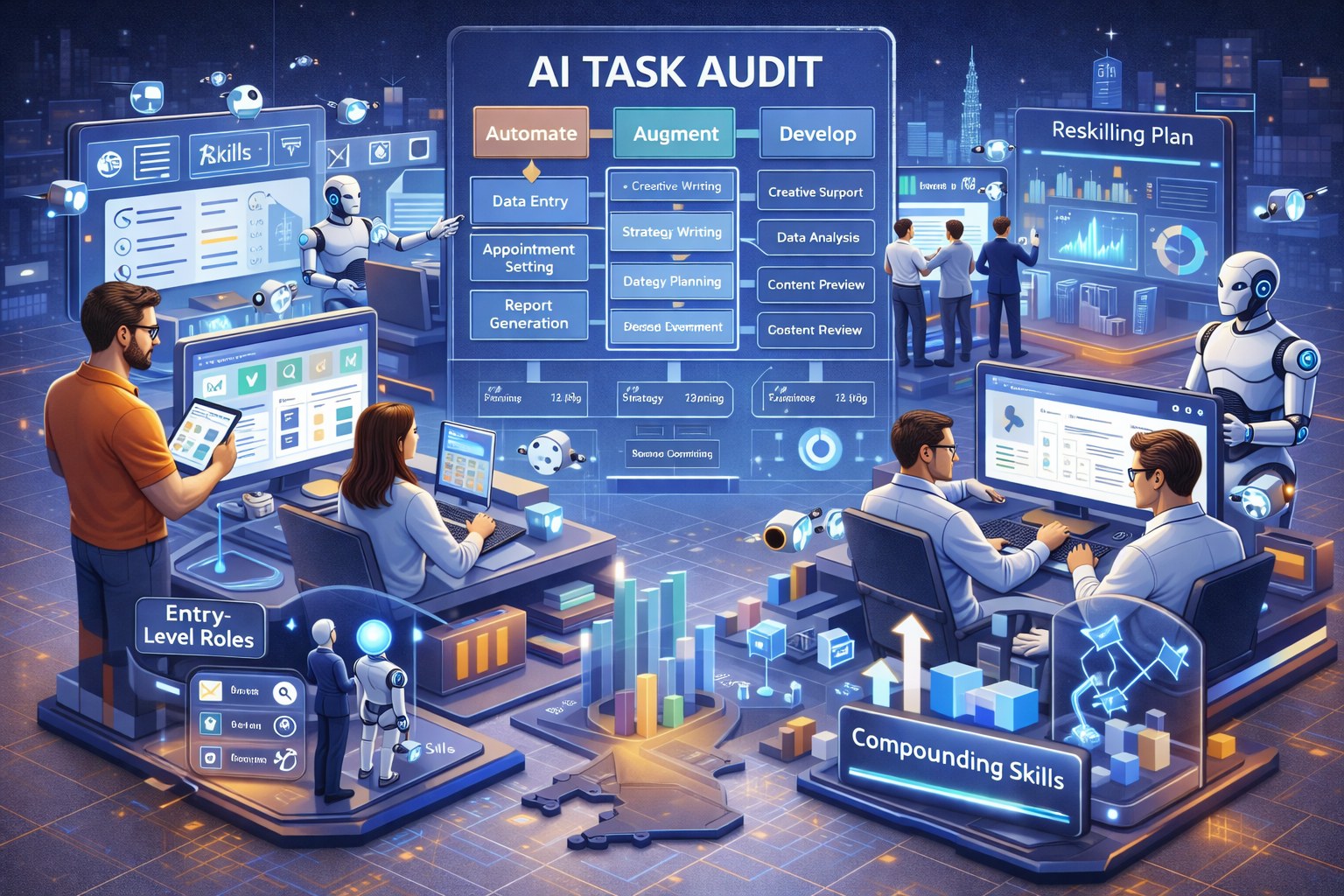
Implication 2: Entry-Level Roles Are Being Restructured, Not Just Eliminated
PwC's analysis of 2.4 million entry-level US job postings reveals that AI-exposed entry-level roles are now seven times more likely to require traditionally senior-level skills - leadership, creativity, face-to-face interaction, strategic judgment - than non-AI-exposed entry-level roles. These "seniorised" entry-level roles have grown 35% since 2019, while other entry-level roles shrank 10%.
For marketing teams, this means that the junior roles being created are fundamentally different from the junior roles being eliminated. A junior content writer who can only produce first-draft copy is being replaced - not by AI, but by a more senior-skilled junior who can direct AI, evaluate its outputs, and add the strategic and creative judgment that AI cannot reliably provide. Hiring and training pipelines need to reflect this shift.
Implication 3: The Organizational Readiness Gap Is the Real Risk
McKinsey's finding that only 28% of marketing organisations are pursuing a fundamental rewiring of their teams and workflows - while 90% are experimenting with AI tools - identifies the central failure mode of 2026. Tool adoption without workflow redesign produces individual productivity gains that do not translate into organizational value. BCG's finding that 66% of AI users receive no guidance on how to reinvest their time savings is the operational manifestation of this gap.
The CMO Survey's finding that marketing headcount growth has slowed by more than 50% from last year's rate, while training budgets have fallen to just 3.8% of marketing spending (down from a pre-pandemic high of 5.8%), suggests that organisations are simultaneously expecting more from AI and investing less in the human capability development needed to use it effectively. This is a structural contradiction that will surface as a competitive disadvantage within 12-18 months.
Implication 4: AI Visibility Is the New Marketing Moat
McKinsey's June 2026 report identifies a shift from an attention economy to a trust economy, where AI recommendation systems increasingly determine which brands get chosen. Nearly half of consumers already use AI-based search to guide purchase decisions. Being visible in traditional search is no longer sufficient - brands must be "consumable" and trusted by machines.
For B2B marketing teams, this means that Answer Engine Optimization (AEO), structured schema markup, entity authority building, and AI-first content architecture are no longer optional SEO enhancements. They are the primary channel through which AI-mediated buyers will discover and evaluate your brand. The teams that have already built these capabilities are compounding their advantage every week.
The Three Actions Every B2B Marketing Leader Should Take This Quarter
Based on the research synthesis above, three actions stand out as the highest-leverage interventions for marketing leaders navigating the AI adoption divide.
First, conduct an AI adoption audit of your team. Map every role against the BCG framework of regular vs infrequent AI users. Identify the specific workflows where AI tools could save time but are not yet being used. The goal is not to create a surveillance mechanism - it is to identify where training and tooling investments will have the highest return. The Gallup data suggests that the risk is concentrated among infrequent users, not non-users: the divide is between those who have integrated AI into their daily workflows and those who use it occasionally or not at all.
Second, redesign at least one core workflow end-to-end, not just add AI tools to existing processes. BCG's finding that organisations using AI to reshape workflows end-to-end create nearly twice the value of those focused solely on tool deployment (42% vs 22% of organisations in 2026) is the clearest evidence that incremental tool adoption is insufficient. Choose one high-volume, high-impact workflow - content production, campaign reporting, competitive research, or lead scoring - and redesign it from first principles with AI as the operating assumption, not an add-on.
Third, invest in AEO and AI search visibility now, before the competitive window closes. McKinsey's data showing that less than 10% of CMOs have scaled AI-driven marketing capabilities means that the majority of your competitors are still in the experimentation phase. The brands that establish AI citation authority, structured schema coverage, and answer-first content architecture in 2026 will have a compounding advantage as AI-mediated search becomes the dominant buyer discovery channel. This is the marketing equivalent of early SEO investment in 2010 - the window for first-mover advantage is open, but it will not remain open indefinitely.
Modi Elnadi's Point of View: The Divide Is a Choice, Not a Fate
The research is clear that the AI adoption divide is real, measurable, and widening. But it is important to resist the framing that positions this as an inevitable technological displacement story. The PwC data is unambiguous: the companies seeing the greatest productivity gains from AI are also growing headcount faster than their less AI-exposed peers. The BCG data shows that AI adoption correlates with higher job satisfaction, not lower. The Gallup data shows that the risk is concentrated among infrequent users - people who have access to AI tools but have not integrated them into their daily practice.
The divide is not between humans and AI. It is between organisations that are investing in the human capability to use AI effectively and those that are treating AI as a cost-reduction tool without the corresponding investment in training, workflow redesign, and strategic clarity. The former are pulling ahead on every dimension: productivity, headcount growth, wage growth, and employee satisfaction. The latter are discovering that AI tool deployment without organizational change produces neither the cost savings nor the productivity gains they expected.
For B2B marketing leaders, the question is not "will AI affect my team?" It already has. The question is "which side of the divide is my team on, and what am I doing to ensure we are on the right side?"
The answer to that question will define the competitive positioning of your marketing function for the next decade.
Modi Elnadi is Founder and Director of Marketing and AI Growth at Integrated.Social, a London-based AI growth marketing agency. He specialises in AI marketing strategy, outcome-based AI deployment, and pay-per-resolution engagement models for B2B technology and professional services clients. Since 2014, Modi has advised commercial leadership teams on translating AI investment into measurable revenue outcomes, from agentic workflow design to AI citation authority and ChatGPT advertising readiness. Connect with Modi on LinkedIn or explore Integrated.Social's AI Marketing Strategy services.