
Improve Google Ads Results: 7 PPC Optimisation Steps (UK)
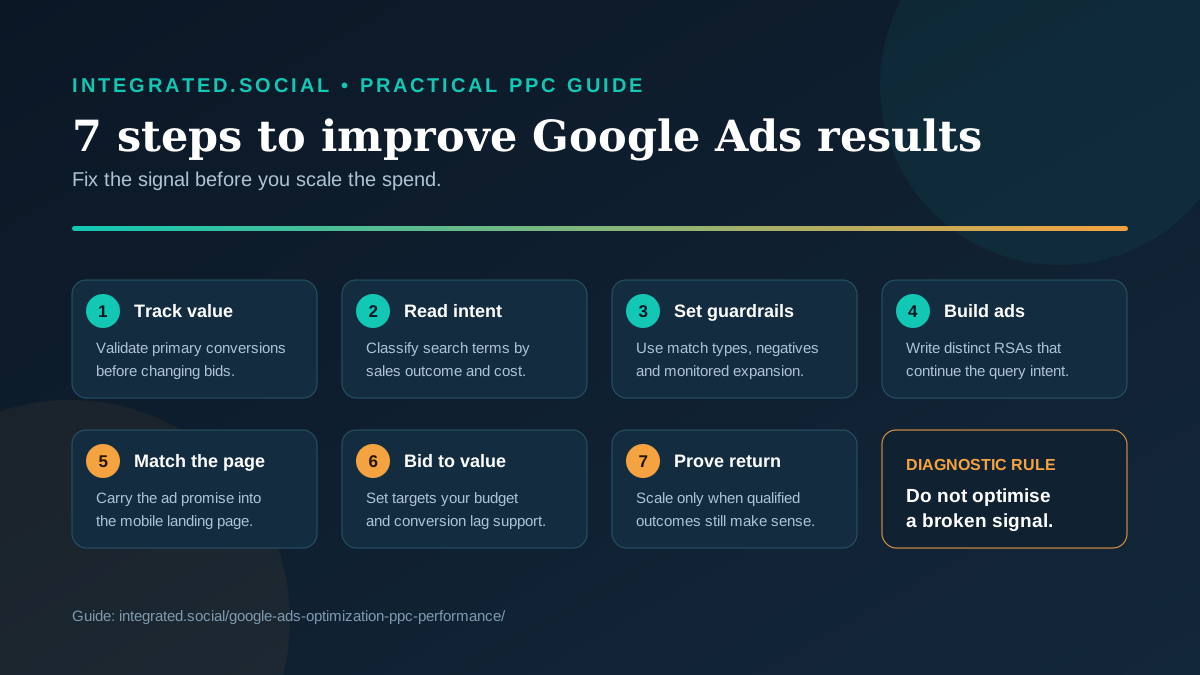
How can I improve my Google Ads results? Fix measurement first, then traffic quality, then ads, then the page, then bids. Verify that valuable conversions fire once, classify search terms by buyer intent, rebuild responsive search ads against matching landing pages, and only then change Smart Bidding, AI Max or budget. Judge progress by qualified acquisitions, incremental revenue and margin, not clicks or account-wide average ROAS.
The seven steps
- Fix conversion tracking and the value model Smart Bidding will learn.
- Analyse search terms by intent, cost and sales outcome.
- Set match types, negatives and commercial guardrails - including AI Max.
- Rebuild responsive search ads and assets around proof and the next action.
- Match landing pages to the query and the ad promise.
- Choose a bidding target the data and daily budget can support.
- Optimise the marginal pound: brand versus non-brand, new customers and incrementality.
By Modi Elnadi, Founder of Integrated.Social. Updated 28 September 2026. This guide reflects practitioner judgement and linked Google Ads documentation. Case-study figures are programme results, not proof that one setting change caused the whole outcome.
Why are your Google Ads not performing?
Google Ads can look healthy while underperforming commercially. A high click-through rate can hide weak lead quality. A low cost per lead can reflect easy, unqualified form fills. A strong account-wide ROAS can mask poor returns from the next pound spent. Diagnose each stage from the visible search query to the CRM outcome before you raise budget.
| Symptom | Check first | Likely cause | First action |
|---|---|---|---|
| Clicks but few conversions | Search terms, page and form events | Wrong intent, weak offer, friction or broken tracking | Test the path on mobile; compare query, ad and page |
| Rising cost per acquisition (CPA) | Cost per click (CPC), conversion rate and query mix | More expensive traffic or weaker conversion | Segment by intent and landing page before changing bids |
| Cheap leads, poor sales pipeline | CRM lead status and primary conversion actions | Bidding optimises for form fills rather than qualified demand | Import qualified-lead or sales outcomes where feasible |
| Revenue flat while spend grows | Marginal return by campaign and new-customer share | Diminishing returns or brand capture | Test budget reallocation and incrementality |
| Performance Max looks strong, Search weak | Brand mix, asset groups and conversion goals | Campaign overlap or different intent mixes | Compare campaign roles and business outcomes, not blended ROAS |
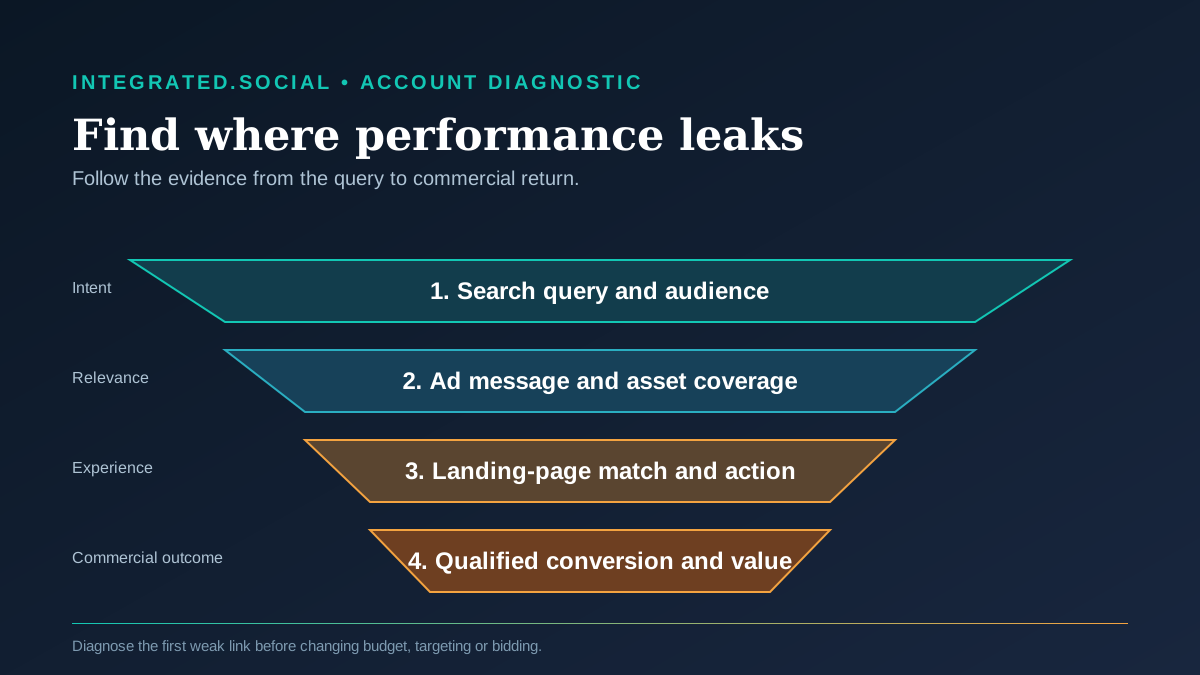
The useful equation: CPA = CPC ÷ conversion rate, for a consistent definition of conversion. At £2 CPC and a 4% conversion rate, CPA is £50. Improving conversion rate to 5% at the same CPC makes CPA £40. That calculation says nothing about whether those customers are profitable, so compare lead quality and value as well.
Why are Google Ads getting clicks but no conversions?
Clicks without conversions can indicate misaligned search intent, an ad promise the page fails to fulfil, slow or confusing mobile design, an unsuitable offer, or broken measurement. Inspect actual search terms and complete the landing page and form yourself before assuming bids are too low. Segment by device, campaign and query theme to isolate the failure.
Why can a lower CPA still be a worse result?
A lower CPA can mean the campaign has shifted towards easier, lower-value customers. If £40 leads rarely become sales while £70 leads become profitable contracts, optimising for the cheaper form fill can damage revenue. Compare qualified CPA, close rate, customer acquisition cost (CAC), contribution margin and lifetime value before declaring a win. For the measurement model across organic, paid and agentic channels, use our CPA and LTV framework.
Step 1. How do you fix Google Ads conversion tracking?
Conversion tracking is the first optimisation task because it defines what automated bidding learns. Identify the actions that represent genuine business value, verify that each fires once, assign realistic values where appropriate, and distinguish primary bidding goals from secondary observations. For lead generation, connect Google Ads to qualified leads, opportunities or sales when privacy and volume permit.
Which conversions should Smart Bidding optimise towards?
Smart Bidding should optimise towards actions that closely predict revenue, with enough timely, reliable volume to support learning. A purchase with accurate value is stronger than a page view; a qualified lead is usually stronger than an unverified form submission. Keep softer events for diagnosis where useful, and review account or campaign goal settings before changing strategies.
Primary vs secondary conversion actions
Primary conversion actions are the goals Smart Bidding and campaign optimisation should learn from - typically purchases, qualified leads or opportunities with a clear commercial meaning. Secondary actions are observed for diagnosis (micro-conversions, page views, soft downloads) but should not drive the bidding strategy. Mis-labelling a soft form fill as primary is a common reason UK accounts look efficient while pipeline stays flat.
Value rules for lead-gen accounts
Where offline or CRM values exist, assign conversion values that reflect expected contribution, not vanity form counts. Value rules can adjust observed values by audience, device or location when those segments have reliably different close rates. Keep rules simple enough to audit: if the sales team cannot explain why a lead is worth twice another, Smart Bidding will learn the wrong priority.
How do duplicate or delayed conversions distort performance?
Duplicate events inflate conversions and mislead bidding. A form submit and its thank-you page should not both count as separate leads. Delayed CRM imports can also make recent days appear weak. Compare Google Ads, analytics and CRM definitions, transaction or lead IDs, attribution windows, consent effects and conversion lag before interpreting daily movements.
Why did conversions drop after a cookie banner or Consent Mode change?
In UK accounts, a new consent banner or a Consent Mode v2 implementation often reduces the conversions Google can observe, even when the underlying demand has not changed. Enhanced Conversions, modelled conversions and offline or CRM imports recover part of that signal. Do not loosen targeting or slash budgets on the first post-banner week until you have compared consented, modelled and imported volumes against the same sales-cycle window.
How do Enhanced Conversions and offline imports improve Google Ads results?
Enhanced Conversions send hashed first-party customer data (for example email) with the conversion so Google can match more consented and modelled outcomes after a cookie banner. For UK advertisers this often recovers usable signal without relaxing consent itself. Implement it through Google Tag Manager or the Google tag, validate that hashing and consent states are correct, and compare observed versus modelled volumes before you retarget bids.
Offline or CRM imports close the gap between form fills and qualified pipeline. Import only stages your sales team trusts (MQL, opportunity, closed-won), use a stable click or GCLID join, and keep the import cadence inside the attribution window. When bidding can see qualified outcomes rather than every soft lead, Smart Bidding usually wastes less on low-intent traffic.
Step 2. How do you analyse search intent and search terms?
The Search terms report shows which visible queries triggered ads and what they cost. Group them by transactional, commercial investigation, informational, navigational and irrelevant intent. Assess each group against your offer and sales cycle: “best”, “pricing”, “reviews” or “alternative” may be close to purchase, particularly for considered B2B and higher-value consumer decisions.
| Intent | Illustrative query | Sensible response |
|---|---|---|
| Transactional | “PPC agency London quote” | Send to a relevant service or enquiry page |
| Commercial investigation | “best Google Ads agency for SaaS UK” | Test proof, comparison and case-study messaging |
| Informational | “how does Google Ads bidding work” | Evaluate educational value and the eventual conversion path |
| Navigational | Your own brand name | Assess brand incrementality and competitor pressure |
| Irrelevant | “Google Ads jobs” for an agency sales campaign | Exclude where genuinely unrelated |
Google's Search terms insights also groups demand into intent-based categories. Use those themes to spot language that individual visible terms may miss; do not treat a category label as proof that a specific unwanted query served. Our brand-bidding incrementality guide explains why branded conversion totals alone do not establish incremental value.
How often should you review search terms?
Review search terms more frequently after launch, major targeting changes or sudden spend shifts, then settle into a cadence that fits account volume and risk. Sort by cost and outcome, investigate new themes, and keep a record of exclusions and promoted terms. A fixed weekly rule is a starting point, not a substitute for monitoring meaningful change.
Step 3. How should you use keywords, match types, negatives and AI Max?
Match types are controls for reach and interpretation, not a simple ranking of good to bad. Use exact and phrase match to protect distinct high-value themes, and test broad match when measurement and Smart Bidding support it. Add negatives for demonstrably irrelevant intent, but check their scope so useful discovery and comparison searches remain available.
Should you use broad match with Smart Bidding?
Broad match can uncover new demand when paired with accurate conversion data, a clear value goal, sensible exclusions and ongoing search-term review. The broader the targeting, the more important the quality of the conversion signal becomes. Test against a defined baseline, allow for conversion lag, and compare qualified outcomes rather than judging broad match on CPC alone.
When should you add a negative keyword?
Add a negative when the query is genuinely outside the offer, geography or buying audience, or consistently fails a commercially reasonable test. Check whether to apply it at ad-group, campaign or account level. Avoid blanket exclusions of “review”, “comparison” and “how to”; their value depends on the product, page, persona and attribution window.
What should you do about AI Max for Search?
AI Max for Search layers extra query matching, text customisation and, where enabled, final URL expansion on top of a Search campaign. From September 2026 Google began automatically upgrading some campaigns that already used campaign-level broad match or standalone automatically created assets. Treat it as a controlled expansion layer, not a replacement for Steps 1 and 2.
Enable or accept AI Max when conversion tracking is clean, brand exclusions exist, and you can review search themes weekly. Constrain final URL expansion if landing-page relevance is already a Quality Score weakness. For Shopping-specific AI Max behaviour, see AI Max in Standard Shopping. For the wider shift toward in-SERP qualification, see Google AI Mode’s Business Agent for Leads.
Final URL expansion: when to constrain it
Leave final URL expansion on only when every eligible landing page can fulfil the same commercial promise as the ad. Constrain or disable it when Quality Score landing-page experience is weak, when regulated claims differ by URL, or when a single high-intent service page must carry the offer. Review expanded landing destinations in search terms and asset reports before you widen budget.
Brand exclusions and search-theme review cadence
Maintain brand exclusions so AI Max does not quietly harvest navigational demand you already win on brand Search. Review AI Max search themes at least weekly after enablement or auto-upgrade, then settle to a risk-based cadence. Promote converting themes into structured keywords where control helps, and exclude themes that burn spend without qualified pipeline.
Step 4. How do you improve responsive search ads and assets?
Responsive search ads (RSAs) need distinct, relevant headlines and descriptions that reflect the searcher's problem, your proof and the next action. Google's Ad Strength guidance recommends at least two RSAs with Good or Excellent ratings per ad group and a unique final URL for each RSA. The hard cap remains three enabled RSAs per ad group. Use that as creative guidance, while evaluating tests against conversions and value.
Build a purposeful mix: product or service, audience, differentiator, objection, evidence and call to action. Add useful sitelinks and other applicable assets. Avoid near-duplicate headlines that merely rearrange the same words. Use page variants when there is a meaningful audience or message hypothesis, and interpret low-volume asset labels cautiously.
How many responsive search ads should each ad group run?
Start with two RSAs that earn Good or Excellent Ad Strength and point to different, relevant final URLs when the message hypothesis differs. A third RSA is optional in high-volume groups. One thin RSA with fifteen near-identical headlines is weaker than two distinct ads. Pin only the line that must appear in every serving.
Does Ad Strength affect Ad Rank or auction eligibility?
Ad Strength gives feedback on the relevance and variety of RSA assets. Google says the rating does not determine whether an ad is eligible to serve and is not used to calculate Ad Rank or Quality Score. Treat it as a creative diagnostic, not as proof of higher auction rank or a substitute for business performance.
Is Quality Score a lever to lower CPC?
Quality Score is a diagnostic indicator, not a direct auction input or primary KPI. Google's guidance distinguishes the reported 1–10 score from the real-time quality assessments used in the auction. Investigate its expected click-through rate, ad relevance and landing-page experience components, then fix the underlying user experience rather than chasing a score. Google explains the distinction here.
Also review brand-asset inheritance when Demand Gen or video sits in the same account. Default inheritance can create off-brand combinations; our note on Google Ads and DV360 brand-asset errors covers the compliance side of that change.
Step 5. How do you improve Google Ads landing pages?
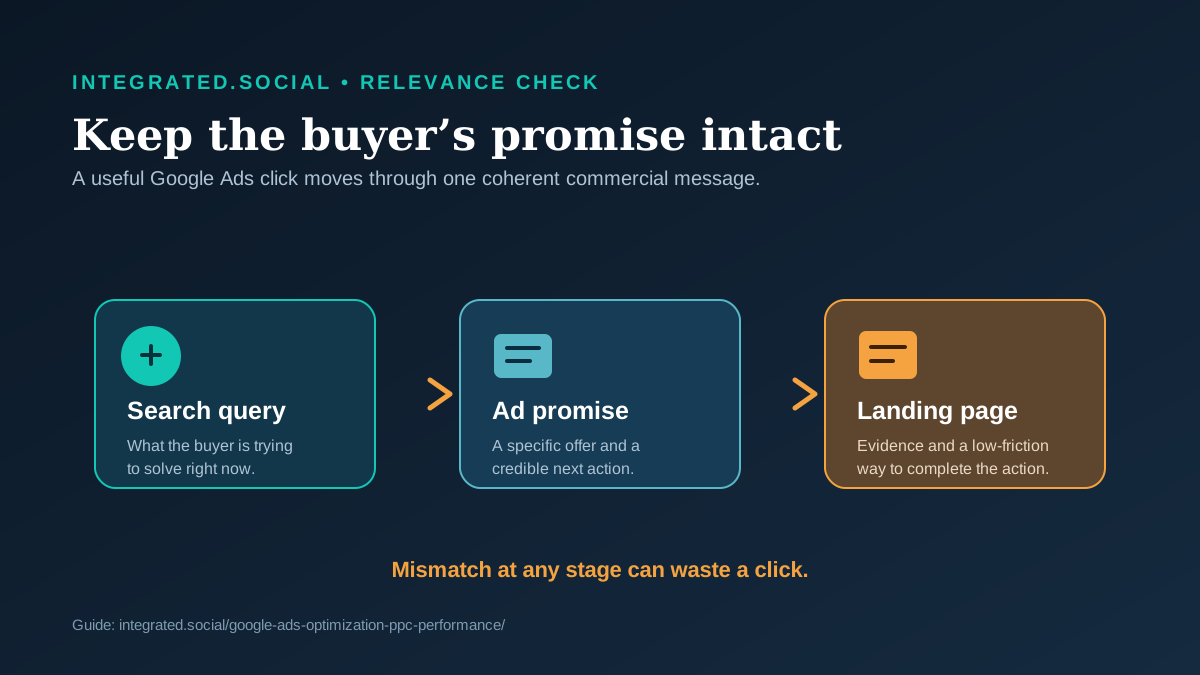
A landing page should continue the exact conversation begun by the query and ad. Match the offer and intent above the fold, show credible proof, explain the next step and make mobile completion easy. Test message, layout and form friction against qualified conversions, rather than judging the page by bounce behaviour or a universal speed threshold alone.
For a UK B2B agency query, a service page with relevant capabilities, case studies and an enquiry path will often beat a generic homepage. For an ecommerce product query, availability, delivery, returns and price transparency may matter more. Regulated categories also require the ad and page to meet applicable platform and UK advertising rules.
Page experience still matters for Quality Score's landing-page component: relevance, transparency, mobile usability and load speed. A slow, cluttered mobile form can erase the gain from cheaper clicks. If you are rebuilding the destination itself, the same semantic and schema discipline used on AI websites - server-rendered HTML, answer-first copy, FAQ and HowTo markup - also helps paid landing pages.
Should every ad group have a dedicated landing page?
Not every ad group needs a unique page. Create distinct pages when user intent, audience objection, offer or evidence differs enough to justify one. Consolidate thin near-duplicates that make maintenance harder. Compare page variants through controlled experiments and check whether improvements hold for lead quality and revenue, not only form conversion rate.
How do UK landing-page claims and ads stay compliant?
Keep ad claims, landing-page promises and evidence aligned. Under UK ASA/CAP principles, absolute claims, savings, rankings and testimonials need substantiation that a reasonable consumer would recognise; financial and other regulated promotions have stricter rules. Match the headline the searcher clicked to the first screen of the page, and avoid inventing urgency or results you cannot evidence. This is practical marketing hygiene, not legal advice - seek counsel for regulated sectors.
Step 6. How do you choose bidding targets and scale budget?
Choose a bidding strategy around the business outcome and the quality of available data. Target CPA suits a reasonably stable acquisition-value model; target ROAS requires meaningful, reliable conversion values. Check conversion volume, lag, seasonality and target constraints before judging a change. Increase budget where additional spend has a credible path to incremental profit.
Do not set a target CPA the daily budget cannot buy. If the target is £100 and the campaign can only spend £40 a day, the system cannot observe enough conversions to learn stably. Either raise budget, loosen the target toward trailing results, or consolidate conversion actions until the maths works.
When should you use target CPA versus target ROAS?
Use target CPA when conversions have broadly similar economic value or when lead values are not yet reliable. Use target ROAS when purchase or imported lead values vary materially and are measured consistently. For long B2B sales cycles, an imperfect revenue import can be worse than a well-defined qualified-lead goal; validate the value model first.
| Decision | Target CPA | Target ROAS |
|---|---|---|
| Optimises for | Conversion volume at a cost target | Conversion value relative to spend |
| Works best when | Conversion values are similar or unavailable | Values are reliable and meaningfully different |
| Main risk | Finds cheaper but weaker leads | Learns from inaccurate or delayed values |
| Business check | Qualified CPA and close rate | Margin, new customers and incremental return |
Should you start with Search or Performance Max?
Start with Search when you need query-level control, a clean negative-keyword discipline and a direct read on commercial intent. Use Performance Max when you have strong creative assets, audience signals and a conversion goal that already represents qualified demand. Many UK B2B accounts run both, with Search capturing high-intent queries and Performance Max extending into other surfaces. Do not judge them on blended ROAS if one is harvesting brand demand the other already owns. The decision framework is in Performance Max vs Smart Campaigns. Specialist execution sits on our Performance Max agency page.
How long should you wait after a Smart Bidding change?
Judge a change over enough conversion cycles to include normal conversion lag and sufficient observed outcomes. A high-volume retail campaign and a low-volume B2B campaign require different windows. Record the change date and avoid stacking several major edits at once. Google's learning indicators can help, but your own sales cycle defines when the result is mature.
Step 7. How do you optimise for incremental growth?
Optimise the marginal pound, not just historical account averages. Separate brand and non-brand demand, new and returning customers, and qualified and unqualified leads. Compare contribution margin after media and fulfilment costs. Where feasible, use experiments or geographic holdouts to estimate what Google Ads added beyond sales that would have occurred anyway.
Published programme results from Integrated.Social illustrate the difference between channel-blend outcomes and a single-toggle claim:
- Destination marketing: 4.8x ROAS, 62% lower cost per lead, and +38% high-value enquiries across paid search, social and programmatic. Those are multichannel results, not proof that one Google Ads change caused the whole outcome.
- UK FinTech persona targeting: +350% new registrations and an 85% CAC reduction through persona-led testing, including 170+ A/B variations.
- B2B SaaS ABM: +312% pipeline growth, 68% shorter sales cycle, £2.4m new pipeline and 4.2x ROAS from ICP-led targeting.
Individual results vary by sector, baseline and budget. See the case study collection for method, not as a forecast.
Which metrics should management see?
Management should see spend, qualified acquisitions, cost per qualified acquisition, pipeline or revenue, margin where available, and the direction of incremental return. Add conversion lag and data-quality notes so recent periods are not misread. CTR, CPC, Ad Strength and Quality Score help diagnose performance, but cannot establish whether the account creates profitable growth.
Brand vs non-brand: what management should split
Report brand and non-brand separately before you declare ROAS healthy. Brand often converts cheaply because demand already exists; non-brand shows whether paid search creates new qualified demand. Split Search from Performance Max by role as well, so blended account ROAS cannot hide cannibalisation or diminishing returns on the next pound.
When a holdout test is worth the cost
A geographic or audience holdout is worth the setup cost when spend is material, sales cycles are measurable and stakeholders disagree about incrementality. Skip heavy experiments when volume is too low to detect a lift, when brand pressure is obvious and already budgeted defensively, or when fixing broken tracking would change the baseline first. Document the hypothesis, holdout design and decision threshold before the test starts.
When should you hire a Google Ads agency in the UK?
Consider specialist support when conversion tracking, campaign complexity, landing-page testing or spend exceeds your team's capacity to diagnose and improve it. Ask how the agency verifies lead quality, tests incrementality, handles Performance Max and AI Max, and reports commercial outcomes. Confirm who owns the ad account and the data. UK pricing commonly uses fixed fees, spend-linked fees or project audits; compare scope as well as price.
A one-off audit is enough when your team can implement the findings. Ongoing optimisation is the better fit when search campaigns and landing pages must improve together, week after week.
Before you hire, insist on:
- Account and data ownership remaining with you.
- A written qualified-lead (or revenue) definition, not form-fill vanity.
- Reporting that separates brand vs non-brand and avoids blended-ROAS vanity as the only scorecard.
Integrated.Social's PPC and Performance Max service covers tracking, intent-led account structure, creative and landing-page testing, and reporting against qualified pipeline and revenue. Organic query language and paid landing pages should share evidence; that loop is the job of SEO, AEO and GEO. If you need the largest leak identified first, request a free AI growth audit.
What should a UK Google Ads audit include before you change spend?
A useful UK audit should leave a sequenced fix list, not only a score. Check at least:
- Primary vs secondary conversion actions, duplicates, values, Consent Mode and Enhanced Conversions.
- High-cost search terms classified by intent and CRM outcome.
- Match types, negatives and AI Max / final URL expansion guardrails.
- RSA coverage, Ad Strength diagnostics and query–ad–page continuity.
- Landing-page match on mobile, claim alignment and form friction.
- Bidding targets versus daily budget maths.
- Search vs Performance Max overlap and brand mix.
- Whether Google Ads conversions reconcile to CRM pipeline.
Only after those checks should you raise or reallocate spend.
What should you do in the next 30 days?
Start with measurement and the most expensive failure point, then run one documented test at a time. In the first week, validate conversions and inspect high-cost queries. Next, segment by intent and lead quality, repair the most mismatched ads and landing pages, and assess bidding after conversion lag. Review the resulting business outcomes before scaling.
| Period | Priority | Decision to record |
|---|---|---|
| Days 1–7 | Audit primary conversions, duplicates, values, consent and lag | What can bidding safely optimise? |
| Days 8–14 | Classify costly search themes, exclusions and AI Max query matching | Which intent deserves more or less budget? |
| Days 15–21 | Test RSA message and the matching landing page | Does the test improve qualified conversion? |
| Days 22–30 | Review bidding, budget, Search versus Performance Max overlap, and CRM outcomes | Where is the next pound most profitable? |
Frequently asked questions about Google Ads optimisation
These answers address the most common decisions behind an underperforming UK Google Ads account: missing conversions, high CPA, broad match, AI Max, bidding and agency support. They summarise the diagnostic framework above. Actual targets and review periods depend on margins, sales cycle, account volume and the reliability of imported conversion data.
How can I improve my Google Ads results?
Improve Google Ads results in this order: repair conversion tracking and the value model, classify search terms by intent and sales outcome, tighten match types and negatives (including AI Max guardrails), rebuild RSAs against the real offer, match landing pages to the query, then set bidding targets your daily budget can support. Only raise spend where the next pound is still profitable after lead quality and margin.
Why are my Google Ads not performing after I increased budget?
A larger budget often buys lower-intent or overlapping demand before the account has fixed tracking, query mix or landing-page match. Smart Bidding may also explore while conversion lag makes recent days look weak. Pause the scale-up, re-check primary conversions and high-cost search themes, then raise budget only on campaigns with a proven qualified acquisition path.
How do I improve Google Ads Quality Score?
Treat Quality Score as a diagnostic of expected CTR, ad relevance and landing-page experience, not a lever you "set". Improve query-to-ad-to-page continuity, remove irrelevant traffic, and fix mobile form friction. Re-measure CPC and qualified conversion rate; do not chase the 1–10 label as the KPI.
Does Consent Mode mean my Google Ads results got worse?
Often the demand is unchanged and Google observes fewer conversions after a UK consent banner or Consent Mode v2 change. Compare consented, modelled and CRM-imported conversions over a full sales-cycle window before you loosen targeting or cut budget. Enhanced Conversions and offline imports usually recover part of the signal.
Can I improve Google Ads myself or should I hire a UK agency?
If tracking is simple and spend is modest, an in-house marketer can run the seven-step checklist. Hire a UK specialist when conversion complexity, Performance Max / AI Max governance, landing-page testing or spend exceeds your capacity to diagnose weekly. Keep account ownership and insist on reporting against qualified pipeline, not blended ROAS alone.
How does Performance Max cannibalise Search results?
Performance Max can look strong while capturing brand or high-intent queries your Search campaigns already win. Split brand vs non-brand, compare incremental outcomes by campaign role, and avoid judging the account on blended ROAS. Use Search for query control and PMax for asset-led expansion once the conversion goal represents qualified demand.
What is a good Google Ads CPA for UK B2B?
There is no universal good CPA. Set the ceiling from contribution margin, close rate and sales-cycle length, then track cost per qualified lead or opportunity, not form fills. A "good" form CPA that never becomes pipeline is a bad commercial result.
How can I improve Google Ads results quickly?
First check that valuable conversions fire once and are selected as bidding goals. Then sort search terms by cost, remove clearly irrelevant demand and inspect the highest-spend landing page on mobile. These checks can expose wasted spend quickly, although sustained CPA or ROAS improvement needs enough conversion data to distinguish a real change from noise.
Why are my Google Ads getting clicks but no sales?
Clicks without sales can reflect low-intent queries, a mismatch between ad and page, price or offer objections, checkout friction, poor lead follow-up or tracking gaps. Trace a sample of real sessions from query to CRM or transaction outcome. If leads exist but fail to close, changing bids alone is unlikely to solve the problem.
How can I reduce Google Ads CPA?
CPA falls when CPC decreases or conversion rate rises, assuming the same conversion definition. Remove irrelevant traffic, improve query-to-page relevance and fix form or checkout friction. Then inspect whether lead quality changed: a lower form-fill CPA with a worse sales close rate may increase true customer acquisition cost.
Can I improve Google Ads results without increasing budget?
Yes. Reallocate spend from irrelevant queries, duplicate conversions and weak landing pages before you add budget. Improving conversion rate at the same CPC lowers CPA without a larger media line. Raise budget only after the conversion goal, query mix and page match can absorb it profitably.
Should I use broad match with Smart Bidding?
Broad match is worth testing when your conversion goal is reliable, budget can support learning and you monitor search themes and lead quality. It may find valuable queries outside a narrow keyword list. If tracking rewards weak leads or exclusions are poorly governed, broader reach can increase waste. Compare against a defined baseline and sales outcomes.
What is AI Max for Search and should I enable it?
AI Max for Search adds broader query matching, text customisation and optional final URL expansion to a Search campaign. Enable it when tracking is accurate and you can review search themes. Constrain URL expansion if page relevance is weak. From September 2026 some campaigns were auto-upgraded; treat the layer as a test with commercial guardrails, not an on/off religion.
Should I start with Search or Performance Max?
Use Search first when you need query control and a clean read on intent. Use Performance Max when assets, audience signals and a qualified conversion goal already exist. Many UK B2B accounts run both and split brand from non-brand so blended ROAS does not hide overlap.
Does Quality Score directly reduce my CPC?
No. The reported 1–10 Quality Score is a diagnostic, not the number entered into the auction. Google uses real-time assessments of factors such as expected click-through rate, ad relevance and landing-page experience. Use component ratings to find weak experiences, then measure the effect of fixes on actual cost and conversions.
Does Ad Strength affect Ad Rank?
Ad Strength is feedback on the relevance and completeness of responsive search ad assets. Google says its rating does not determine ad serving eligibility. Improve weak assets when they point to a plausible creative gap, but assess the campaign by qualified leads, sales and value. A Good or Excellent label is not itself a commercial result.
How many responsive search ads should I run per ad group?
Google's Ad Strength guidance recommends at least two responsive search ads with Good or Excellent ratings per ad group and a unique final URL for each ad. The limit is three enabled RSAs. Two distinct ads beat one padded ad. Pin only copy that must always appear.
What is a good Google Ads ROAS?
There is no universal good return on ad spend (ROAS). A 4x revenue-to-ad-spend ratio may be profitable for a high-margin product and inadequate for a low-margin one after fulfilment and operating costs. Set a threshold using gross or contribution margin, repeat purchase behaviour and incrementality, then compare new-customer and branded performance separately.
Should my Google Ads send traffic to the homepage?
Use the page that best fulfils the query and ad promise. A homepage can work for a broad brand search, but a relevant service, category or product page usually gives specific non-brand visitors a clearer route to action. Test mobile usability and qualified conversion. Avoid creating near-identical pages merely to increase page count.
Why did conversions drop after I added a cookie banner?
Consent Mode and a stricter cookie banner reduce the conversions Google can observe. Demand may be unchanged. Check consented versus modelled conversions, Enhanced Conversions and CRM imports before you change bids. Recalibrate targets only after you understand the measurement gap.
How long does Google Ads optimisation take to show results?
Tracking repairs and exclusions can change reported data or spend immediately, but a reliable performance conclusion takes enough conversions and time for their normal lag. A short-cycle ecommerce campaign can be assessed sooner than a B2B pipeline campaign. Document the baseline and avoid judging immature recent conversions as final.
When should I hire a PPC agency?
Hire a PPC specialist when the value of better measurement, account structure and experimentation is likely to exceed the fee and internal effort. Ask for a diagnostic plan, ownership of the ad account and data, a lead-quality definition, and reporting tied to revenue. A one-off audit may be sufficient if your team can implement it.
What does a Google Ads audit include?
A useful audit inspects conversion actions, Search terms, match types, RSA and asset coverage, landing-page match, bidding targets versus daily budget, Search and Performance Max overlap, and whether reported conversions match CRM outcomes. It should leave you with a sequenced fix list, not only a score.
Can SEO and Google Ads lower acquisition costs together?
Paid search terms can reveal high-intent language for organic pages, while organic content can answer comparison questions before a paid click. Shared landing-page research can improve relevance across channels. Do not simply add organic and paid attributed conversions to claim a combined saving; test incremental effects and account for overlap.
Related tools and services
Sources and related reading
Google's Quality Score guide, RSA Ad Strength guidance and Search terms insights documentation support the platform-specific statements above.
On Integrated.Social, continue with the brand PPC incrementality analysis, CPA/LTV framework, Performance Max vs Smart Campaigns, ChatGPT Ads UK decision framework, AI Max in Standard Shopping and the published case studies.
Resources for this workflow
Affiliate links. As an Amazon Associate I earn from qualifying purchases. Product price and availability are shown on Amazon UK.

The AI Marketing Canvas
A five-stage framework for using AI in marketing strategy, personalisation, and customer acquisition.

Competing in the Age of AI
Harvard Business School professors explain how AI transforms operating models, network effects, and competitive strategy.
AI for Business: A Practical Guide
How business leaders can extract real value from artificial intelligence - from strategy to implementation.
Get the Google Ads Measurement Checklist
Document conversion definitions, tag and consent checks, reporting caveats, and the next evidence-backed action before you optimise a campaign around a number you cannot explain.
We use your email only to send this requested resource. This is not a marketing subscription.