Saudi Arabia's national AI company, HUMAIN, has had a defining quarter. On November 1, Aramco closed its acquisition of a 49% stake in HUMAIN, with the Public Investment Fund (PIF) keeping 51%. Eight days later, HUMAIN signed up to SAR 2.5 billion (about $667 million) of financing for its first AI data center facilities. Between August and November it also added compute partners, a bank-grade software investment, an enterprise acquisition and two product launches. This article separates the verified facts from company claims and plans, then explains why the direction of travel favors the Kingdom.
Jump to: What happened: Aramco takes 49% of HUMAIN | Financing and power: SAR 2.5 billion for the first AI data center facilities | Compute partners: NVIDIA, Together AI and Oxagon | Software and services: MOZN, CNTXT, HUMAIN Voice and HUMAIN Plus | Fact, claim or plan: how to read the HUMAIN numbers | Why Saudi Arabia is on the right track | What still needs proof | What this means for B2B marketers in the Gulf
What happened: Aramco takes 49% of HUMAIN
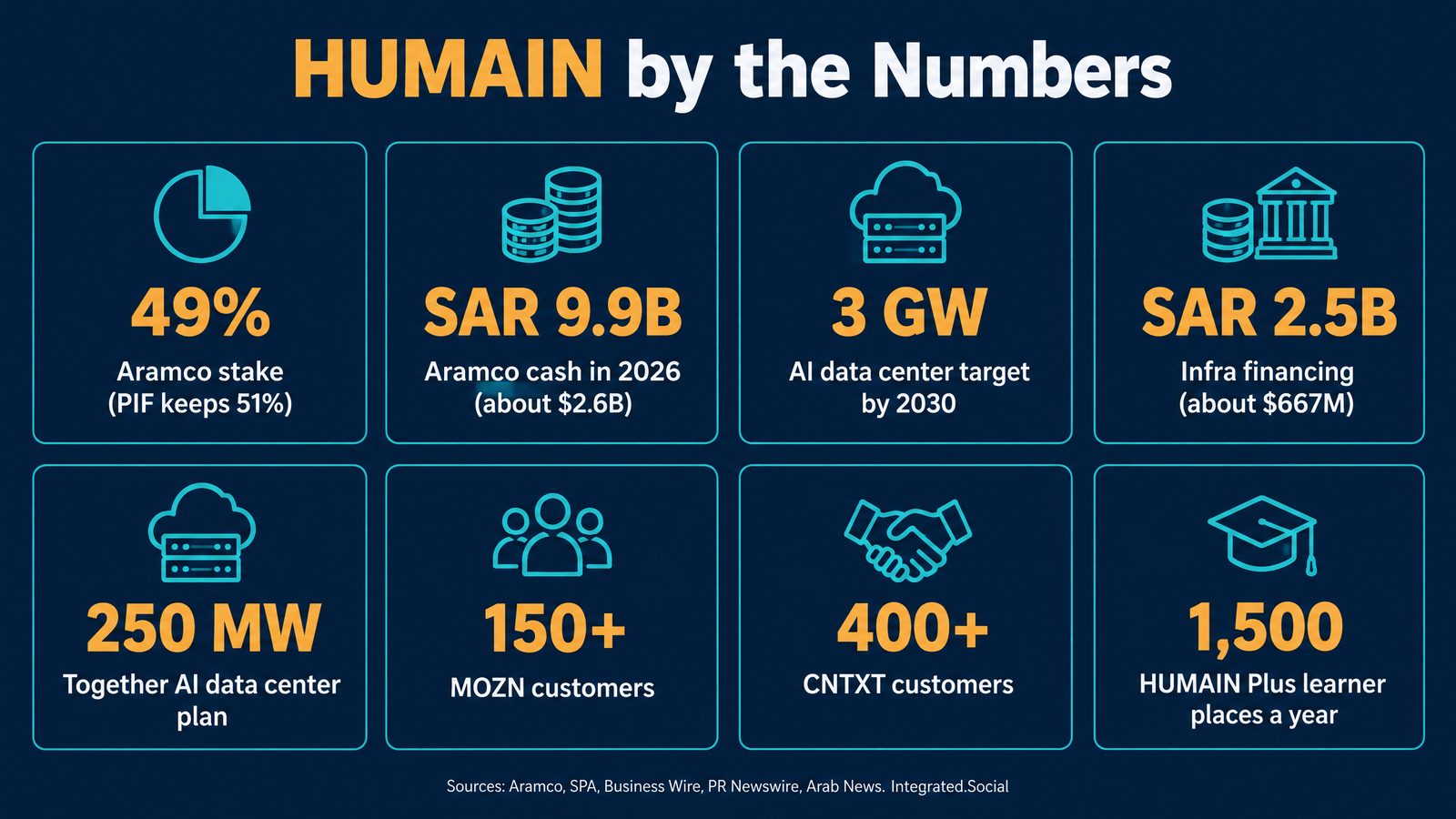
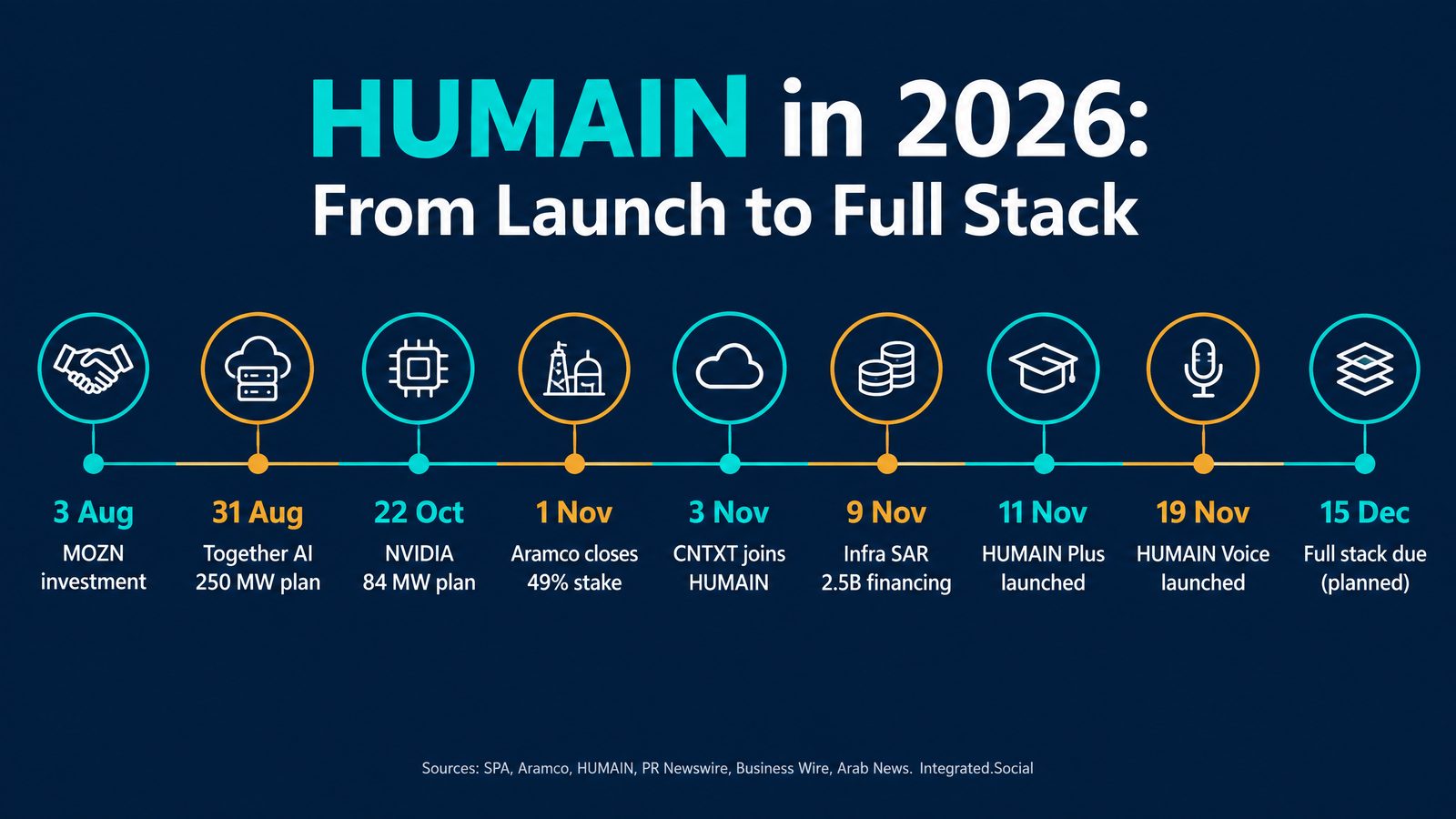
According to Aramco's November 1 release and the Saudi Press Agency, Aramco will acquire 49% of HUMAIN through a wholly owned subsidiary, and PIF will retain 51%. Aramco says it will transfer key AI assets and contribute about SAR 9.9 billion ($2.6 billion) in cash in 2026, alongside AI, compute and digital assets. The transaction formalizes a non-binding term sheet reported in October 2025, according to Fast Company Middle East.
HUMAIN launched in May 2025 around four pillars: data centers, infrastructure and cloud, models including ALLaM (an Arabic multimodal large language model), and AI solutions. The stated ambition is 3 GW of AI data center capacity by 2030 and a position among the leading exporters of AI. Aramco CEO Amin Nasser cited $11.3 billion of "Technology Realized Value" since 2023 as evidence of the company's AI track record. That figure is Aramco's own metric, not an audited AI revenue number.
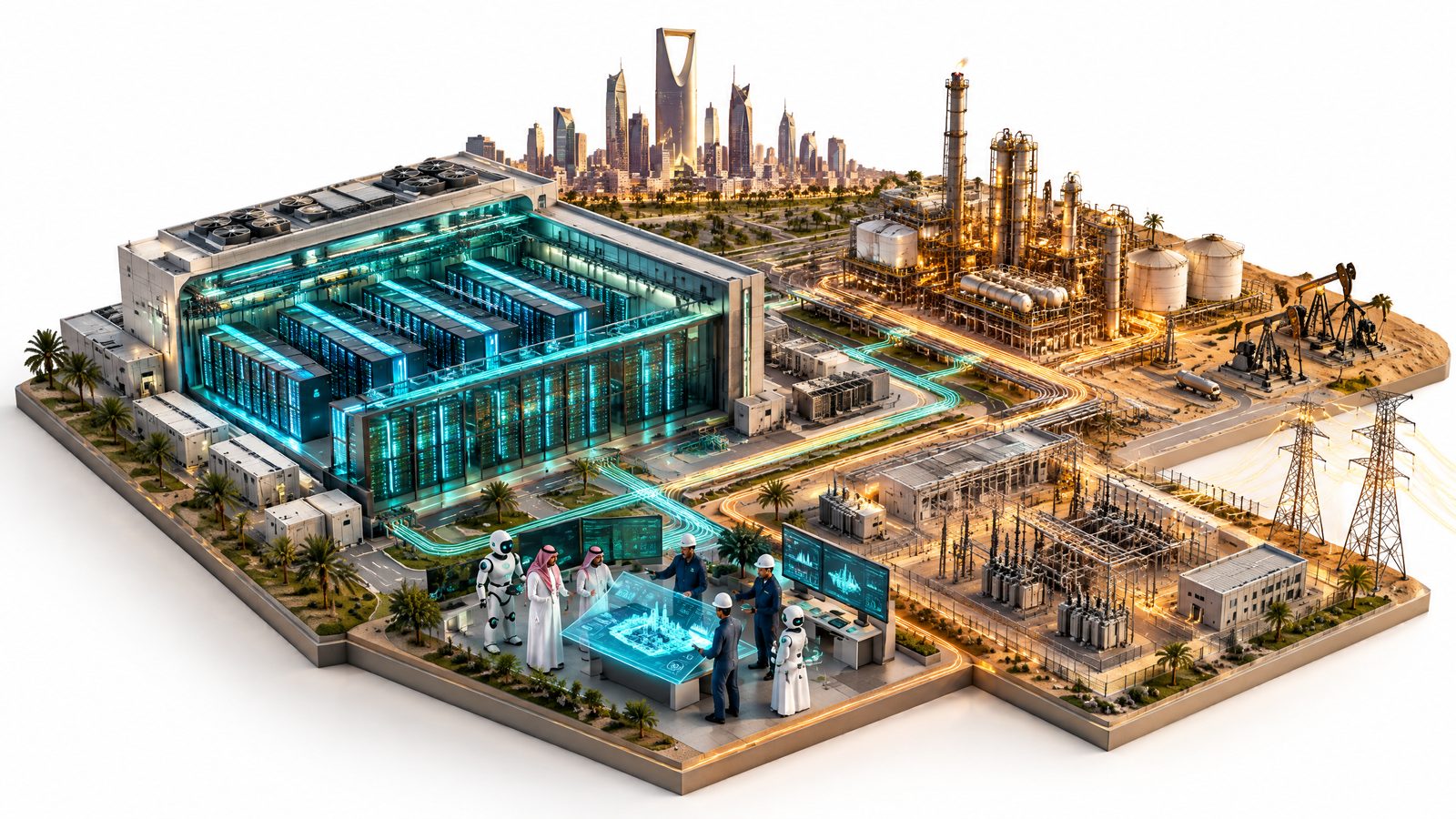
The structural point matters more than the headline. An energy producer with industrial data, engineering talent and large internal demand is now a co-owner of the national AI platform. That pairing of an anchor customer with a sovereign owner is rare among regional peers, and it is the best signal yet that HUMAIN's demand is not purely speculative. For context on the capital structure, see our earlier analysis of HUMAIN's infrastructure and IPO preparation.
Financing and power: SAR 2.5 billion for the first AI data center facilities
On November 8 in Riyadh, HUMAIN signed two agreements with Infra totaling up to SAR 2.5 billion, according to the Saudi Press Agency and DatacenterDynamics. They are the first transactions under Infra's AI Data Center Financing Program and build on a non-binding framework of up to SAR 4.5 billion ($1.2 billion) announced at Davos in January 2026.
The two facilities are specific:
- GPU financing: up to SAR 1.1 billion ($293.3 million) for about 25 MW of IT load.
- Grid and substations: up to SAR 1.4 billion ($373.3 million) for substations, transmission and grid connections, designed to support future data center development of up to 1 GW of IT capacity.
Financing against named assets is a different kind of evidence from a capacity ambition. Lenders price delivery risk, so a signed facility says more than a press-conference target. DatacenterDynamics also reports that HUMAIN holds more than 200 plots of land for development. Our Gulf sovereign AI comparison shows how this funding model differs from the UAE and Qatar approaches.
Compute partners: NVIDIA, Together AI and Oxagon
Capacity is being assembled from several directions:
- NVIDIA: HUMAIN announced plans for up to 84 MW of AI compute with roughly 27,000 NVIDIA GPUs, with first Blackwell deployments targeted for Q4 2026 and later phases in 2027. We covered the phases and caveats in our HUMAIN and NVIDIA 84 MW analysis.
- Together AI: announced at LEAP on August 31, a new 250 MW data center in Saudi Arabia that the companies expect to generate more than $5 billion in gross annualized revenue in its first year. The revenue figure is a forward-looking company expectation. The New York Times DealBook reported the plan at 250 MW of electricity and 120,000 chips.
- Oxagon (NEOM): on October 21, HUMAIN and DataVolt signed a preliminary agreement with Nebius for up to 50 MW. Fast Company Middle East reports 100 MW of an initial 360 MW phase under construction, with operations phased from Q4 2027. See our Oxagon giga-campus economics piece.
Software and services: MOZN, CNTXT, HUMAIN Voice and HUMAIN Plus
Infrastructure only matters if software and services use it. Four moves in the last four months point that way.
MOZN. On August 3, HUMAIN Ventures made its first investment in a Saudi company, MOZN, as one of its first engagements in banking, financial services and insurance. The release cites 150+ MOZN customers and priority use cases in financial crime prevention, knowledge intelligence and governance, risk and compliance. Solutions will be distributed through the HUMAIN ONE AI Agent Marketplace. The investment amount was not disclosed.
CNTXT. On November 3, HUMAIN announced a controlling interest in Riyadh-based CNTXT, a company formed by Aramco and others. Trade coverage cites 400+ corporate and government customers and revenue growth of more than four times in three years. Terms were not disclosed.
HUMAIN Voice. Launched November 19, it is an Arabic-first speech platform combining speech recognition, text-to-speech and full-duplex voice agents across Najdi, Hijazi, Khaleeji and other dialects, plus Arabic-English code-switching, according to HUMAIN and Middle East AI News. An 80-million-parameter open-weight recognition model is released under Apache 2.0. For the wider Arabic speech context, read our piece on NVIDIA's Saudi Arabic speech dataset.
HUMAIN Plus. Announced on November 11 with VUZ, the program's Riyadh campus is designed for about 1,500 learner places a year, with GPU-backed builder labs, according to PR Newswire. Operational launch is planned for Q1 2027. Talent is the layer most national AI strategies underfund.
Fact, claim or plan: how to read the HUMAIN numbers
| Item | Status | Source type |
|---|---|---|
| Aramco acquires 49%, PIF holds 51% | Closed fact | Aramco release, SPA |
| Up to SAR 2.5B Infra financing signed | Signed fact | SPA, DatacenterDynamics |
| About 25 MW GPU facility, grid for up to 1 GW | Facility design | SPA |
| 3 GW capacity by 2030 | Plan | Aramco release |
| 84 MW NVIDIA program, 250 MW Together AI site | Plans | Company announcements |
| More than $5B first-year revenue (Together AI) | Company expectation | Business Wire |
| MOZN 150+ and CNTXT 400+ customers | Company-reported | Press releases, trade press |
| Full AI stack on December 15, 3 trillion parameter open-weight model, 88% lower cost | CEO statements and plans | Arab News |
The last row deserves care. HUMAIN CEO Tareq Amin told Arab News that the full stack arrives on December 15 and claimed 88% less cost and token consumption than models outside the country. Treat those as planned, unverified claims until independent benchmarks and general availability confirm them.
Why Saudi Arabia is on the right track
My view is that Saudi Arabia is on the right track for three reasons that are visible in the evidence, not in the rhetoric.
First, ownership of the stack. HUMAIN spans power-adjacent infrastructure, cloud, Arabic models, voice, enterprise software and training. Few markets can say that, and it shortens the path from a GPU order to a paying workload.
Second, an anchor buyer and a patient owner. Aramco's stake pairs a sovereign investor with an industrial customer, and the Infra facilities show domestic lenders will finance assets, not just announcements. That is how regional compute becomes competitive with global hyperscalers on cost of capital.
Third, Arabic as a real moat. Dialect-aware speech, ALLaM-class language models and sector solutions such as MOZN address a language and compliance gap that global providers serve unevenly. The Oxford Business Group, cited by TMCnet, estimates the Saudi AI market growing from about $1.2 billion in 2025 to $4.4 billion by 2034. It is a secondary estimate, but the direction is consistent with the capital being committed.
Regionally, this keeps the Kingdom in the same conversation as Abu Dhabi's G42 and MGX platform and Qatar's $20 billion Qai venture. Internationally, the Together AI and NVIDIA programs test whether Saudi capacity can serve global customers. Our wider read on regional capital flows is in the Middle East AI investment overview.
What still needs proof
Positive momentum is not delivery. The proof points to watch are concrete: whether the first GPU facility goes live on schedule, whether grid connections arrive before demand, whether the December 15 stack ships with independent benchmarks, and whether Oxagon moves from a preliminary agreement to operations in Q4 2027. Customer utilization and pricing will show whether capacity converts into revenue. No source reviewed for this article discloses HUMAIN revenue or margins.
What this means for B2B marketers in the Gulf
If you sell into Saudi and Gulf enterprises, the buying journey is shifting toward a national stack. Procurement teams will increasingly ask AI assistants which local providers handle Arabic data, compliance and sovereignty. Brands that publish clear, source-qualified, bilingual answers will be easier for those assistants to cite. That is the core of AI search visibility and answer engine optimization, and the commercial positioning behind it is covered in our AI marketing strategy service. An Arabic version of this article is available in our Arabic news section.
Sources
- Aramco: PIF and Aramco close HUMAIN transaction (November 1, 2026)
- Saudi Press Agency: Aramco and PIF HUMAIN transaction
- Fast Company Middle East: Aramco completes $2.6 billion acquisition of 49% stake
- Saudi Press Agency: HUMAIN and Infra financing agreements (November 9, 2026)
- DatacenterDynamics: HUMAIN raises $667M for AI buildout
- PR Newswire: HUMAIN invests in MOZN (August 3, 2026)
- Business Wire: Together AI and HUMAIN strategic partnership (August 31, 2026)
- The New York Times DealBook: Together AI and HUMAIN (August 31, 2026)
- HUMAIN: CNTXT joins the full-stack AI platform
- TMCnet Insight: HUMAIN acquires CNTXT
- PR Newswire: HUMAIN Plus with VUZ (November 11, 2026)
- Arab News: HUMAIN CEO unveils December AI stack rollout
- HUMAIN: HUMAIN Voice launch (November 19, 2026)
- Middle East AI News: HUMAIN launches Arabic-first voice
About the Author
Modi Elnadi is the founder of Integrated.Social. He works with B2B teams on AI market positioning, answer-engine visibility and commercial growth strategy. His approach is evidence-led: separate a company's stated plan from delivered operating proof, connect each development to the buyer question it changes, and treat announcements as signals to verify rather than outcomes to assume.