
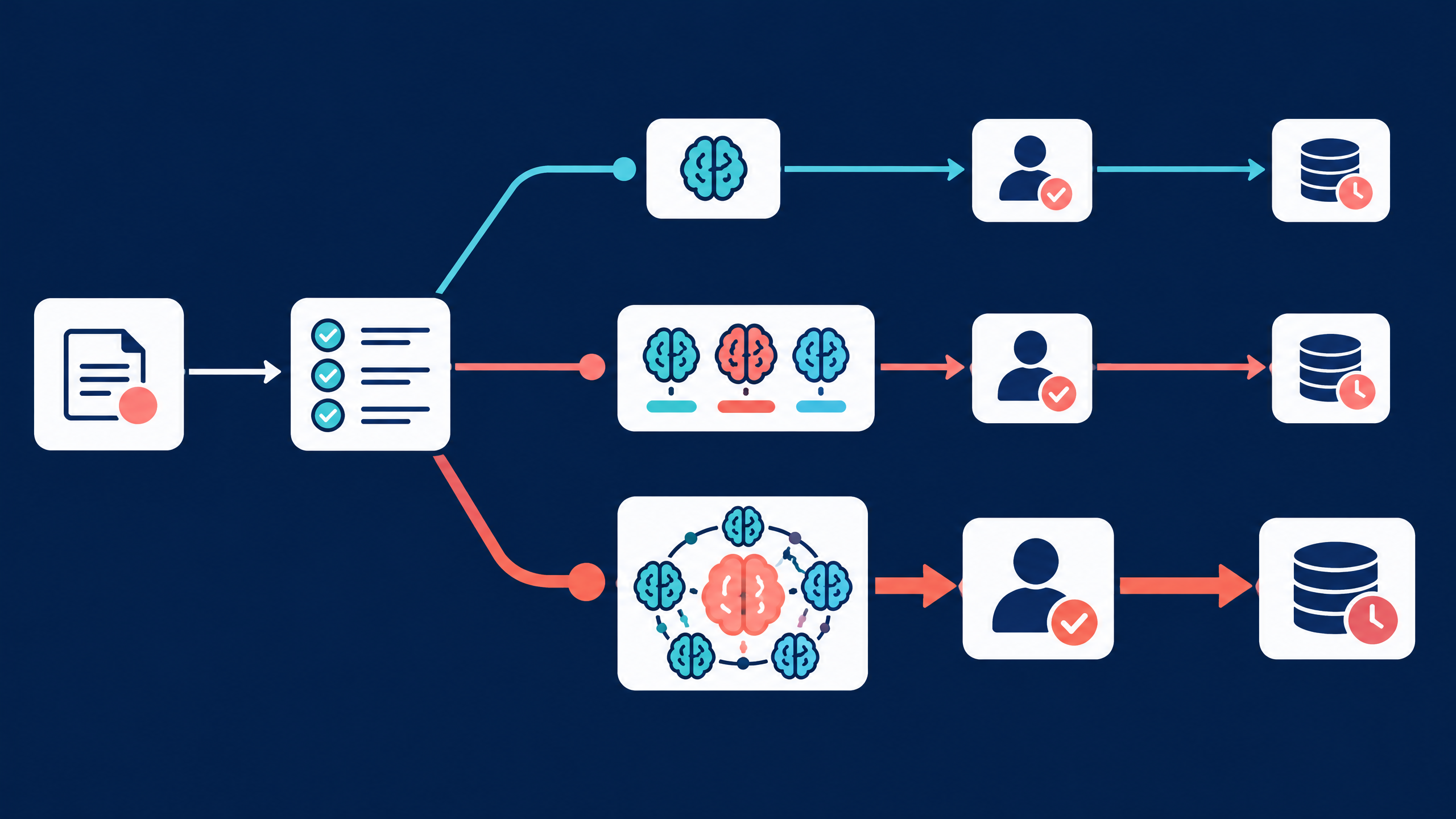
Marketing teams do not need one universally “best” AI model. They need a repeatable way to decide which model, configuration, tool access, validation checks, and human review path fit a particular piece of work.
That distinction matters in B2B marketing. Turning approved product facts into paid-social variants is different from synthesizing customer research for executive positioning. Normalizing campaign taxonomy is different from drafting a public statement with product claims. One blanket rule will either apply more capability than the work needs or under-protect a consequential decision.
The operating question is not, “Which model wins?” It is: “What must this task produce, what defects are unacceptable, and who may approve the result?” Answer those questions first. Then compare candidate routes using representative work and select the least complex route that reliably clears the agreed quality bar.
Model routing is an operating decision, not a model preference
Model routing is the policy and workflow that directs a request to an appropriate model and review path. The route may account for input sensitivity, task complexity, required tools, output destination, time constraints, quality threshold, and the consequence of an error. Its output should be more than a model identifier. It should define the inputs, instructions, model or models, settings, source access, validations, and approval boundary.
For marketing teams, writing fluency is not enough evidence that an output is ready. A polished paragraph may still introduce an unapproved claim, omit a required qualification, change a product fact, or miss the intended positioning. The route must test the conditions that make a deliverable usable in its real destination.
OpenAI’s model-selection guidance offers a useful, vendor-specific example of this approach. It advises teams to define acceptance criteria before comparing models, use the same inputs, repeat the comparison across representative tasks, and measure completion time alongside review and repair effort. It also recommends retaining the lightest setting that meets the quality bar.
Those are durable operating practices. Individual model names, availability, pricing, capabilities, and recommendations are vendor-specific and can change. Even within a provider, behavior can change with reasoning settings, tools, structured-output requirements, instructions, and retrieved context. Build routing around acceptance criteria and observed evidence—not a permanent model hierarchy.
Start with the task, then define “acceptable”
Begin with the job rather than a requestor’s preferred model. Identify the intended action, audience, source materials, output destination, and reversibility. Then translate the quality bar into observable checks.
“Make it good” cannot route work. “Create five subject lines using only the approved message house, include no performance claims, meet the character limit, and require marketer approval before scheduling” can. The second instruction supplies a testable definition of readiness and clarifies whether automated action is appropriate.
Practical task-to-acceptance-criteria table
| Marketing task | Acceptance criteria before routing | Approval boundary | Route design question |
|---|---|---|---|
| Normalize campaign names and UTM values | Follows the current taxonomy; preserves required fields; flags missing inputs; validates against a schema | Automated only with reversible validation and an exception queue | Can deterministic checks reject malformed rows? |
| Create variants from approved copy | Preserves approved facts and qualifiers; meets channel limits; introduces no new claims | Marketing review before publishing | Is source-grounded transformation sufficient, or is brand judgment needed? |
| Summarize customer-call themes | Uses the supplied corpus; separates evidence from interpretation; handles sensitive information under policy | Research or marketing-operations review before sharing | Are sources complete, permissioned, and traceable? |
| Draft a technical B2B article | Addresses the brief; supports factual assertions with approved sources; flags unresolved claims | Subject-matter and editorial review before external use | How much research and verification does the deliverable require? |
| Produce account research for outreach | Uses authorized, current sources; labels uncertainty; avoids sensitive inferences | Sales or marketing review before outreach | Could a weak inference damage a relationship or create a policy concern? |
| Propose budget reallocations | Uses verified inputs; states assumptions; preserves calculation traceability; makes no changes | Authorized owner approves every action | Is the system advising, or making an operational decision? |
This is deliberately not a model ranking. A frequent, narrow, schema-validated transformation may suit a lower-complexity route. A research-heavy narrative that must reconcile conflicting evidence may need a more capable route and stronger review. The criteria—not the generic task label—decide.
Put the approval boundary in the route
An approval boundary specifies what the system may do without a human and where a named reviewer must decide. It is a control on business impact, not a penalty for using AI. In marketing, the most useful distinctions are often drafting versus publishing, recommending versus changing spend, extracting versus interpreting, and tagging versus contacting a person.
Use a small set of explicit boundaries:
- Automate and log low-impact, reversible work with deterministic validation, such as formatting approved data or routing incomplete requests to an exception queue.
- Generate for review when a person must check defined criteria before content or research is reused or distributed.
- Require dual review for product claims, sensitive inputs, material brand decisions, or work with legal or policy implications. Name the roles required.
- Do not delegate the decision when an accountable business owner must retain authority, even if AI assembles evidence, scenarios, or a draft.
Make the boundary operational, not merely documented in a policy. Keep a work record that captures the route, source set or retrieval version, prompt or template version, validator results, reviewer decision, and material edits. This makes failures easier to investigate and routes easier to improve.
This approach is consistent with careful governance framing, not a claim of compliance. NIST describes its Artificial Intelligence Risk Management Framework: Generative Artificial Intelligence Profile as a voluntary, cross-sector companion resource intended to help organizations incorporate trustworthiness considerations into the design, development, use, and evaluation of AI systems. Marketing leaders can adapt that lifecycle mindset by identifying context and stakes, measuring outputs against criteria, managing responses, and keeping accountable owners involved. It does not replace legal, privacy, security, accessibility, or industry-specific obligations.
Teams that need to formalize ownership, controls, and review pathways can explore AI governance services for support translating workflow risks into operating practices.
Compare routes with representative work
A vendor demonstration is not an evaluation. Create a small, versioned set of task packets drawn from real work. Include straightforward requests, messy source material, incomplete briefs, conflicting facts, constrained formats, and known edge cases. Handle sensitive content according to organizational policy before testing.
Hold the relevant variables steady for each candidate route: task packet, instructions, source set, output format, and scoring rubric. When testing reasoning effort or tools, change one variable at a time. Where practical, have qualified reviewers score outputs without seeing the provider name.
The rubric should score the criteria that matter for the task: factual grounding, claim fidelity, completeness, audience fit, voice, format compliance, source traceability, uncertainty handling, and validator success. Record defects by category rather than as a general thumbs-up—for example, unsupported claim, missing qualifier, invented citation, invalid taxonomy, or failure to flag ambiguity.
Measure the complete route, not only first-draft quality. Capture turnaround time, review effort, repair effort, retry frequency, and operational failure modes such as malformed structured output or failed tool use. These observations are inputs to a routing decision, not guarantees of performance. The useful route is the one that meets the agreed threshold for the relevant work under realistic conditions.
Minimum comparison protocol
- Define acceptance criteria and the approval boundary before reviewing outputs.
- Build representative task packets and a scoring rubric.
- Run each route on the same packets; document versions, settings, tools, and date.
- Have qualified reviewers record scores, defects, and repairs.
- Choose the least complex route that meets the threshold across the set—not only on a polished sample.
- Re-test after a material change in model, provider, prompt, retrieval corpus, tool integration, policy, or task mix.
Design a portfolio, not a monolith
A multi-model workflow can assign different roles to low-risk extraction, structured classification, source-grounded drafting, research synthesis, quality checking, and human approval. It can also direct a failed validation to an escalation route. However, every additional handoff creates governance work: access controls, source provenance, retention rules, error handling, and observability.
Start with a small portfolio: a default route for a well-bounded category, an escalation route when criteria cannot be met, and an exception process for novel or high-stakes work. Do not allow silent fallbacks that change sensitive-data handling or reduce the required approval level. A fallback must inherit the appropriate controls.
This is especially important in agentic workflows. An agent needs an explicit completion check, bounded tool permissions, and a clear stop condition. A fluent completion message is not proof that an external action succeeded. Organizations building governed, task-specific automation can consider Gemini agentic AI services when implementation support is needed beyond model selection.
Keep routing alive after launch
A routing policy becomes stale when it is treated as a one-time procurement decision. Set review triggers: a model-version change, newly enabled tool, change in source access, recurring defect, new channel, higher-stakes task, or material shift in brand or regulatory requirements. Review the evaluation set as well; clean historical inputs may no longer represent current work.
Assign owners for the rubric, model configuration, source governance, and approvals. Give users a compact route card that states the task scope, approved inputs, acceptance checks, prohibited uses, owner, reviewer role, and escalation path. That turns routing into a quality and judgment practice rather than a simple cost-control mechanism.
The durable advantage is not predicting which model will lead next quarter. It is knowing what “ready” means for each marketing task, testing alternatives against that definition, and requiring human approval when the business consequences demand it.## Sources
- OpenAI, “Model selection”. Accessed November 1, 2026. Consulted for vendor-specific guidance on acceptance criteria, same-input comparisons, representative tasks, review and repair effort, and selecting the lightest setting that clears the quality bar.
- National Institute of Standards and Technology, Artificial Intelligence Risk Management Framework: Generative Artificial Intelligence Profile (NIST AI 600-1), July 2024. Consulted as voluntary, cross-sector governance framing; not legal or compliance advice.
Proposed framework figures
- Planning framework — “The Model Routing Triangle.” A triangle connecting Task Definition, Acceptance Criteria, and Approval Boundary, with the resulting route at the center. Caption: “A planning framework for assigning AI marketing work.”
- Governance workflow framework — “From Request to Approved Outcome.” A flow diagram: request → classify task and inputs → route configuration → generate or use tools → validate → approve or escalate → log and learn. Caption: “A workflow framework, not a performance comparison.”
- Evaluation framework — “Representative Evaluation Scorecard.” A blank matrix comparing candidate routes across factual grounding, format validity, review effort, and exceptions for a defined task set. Caption: “Scores must come from an organization’s own tests.”